Air-cooled or evaporative: the choice, and what it costs us
One of these uses millions of gallons and runs cheaper. We took the other one.

Published by theEdge, the applicant in Case Z2026-12. This is our account of our own project.
The fear people bring to public meetings about water is not irrational, and it is not about this building. It is about a different machine, and the difference is worth explaining properly rather than waving away.
When someone says a data center drinks millions of gallons, they are describing evaporative cooling. That is a real technology, it is genuinely thirsty, and it is what most large facilities use. The concern has a factual basis. What it does not have is any application to equipment that works a different way.
Two ways to move heat
Computers turn electricity into heat. That is not a design flaw; it is thermodynamics. Every watt that goes in comes back out as heat, and the entire cooling question is how you get rid of it.
There are two common answers.
Evaporative cooling uses water's phase change. Water absorbs a large amount of energy when it turns to vapour — far more than simply warming it up — so if you let water evaporate, it carries the heat away with it. That is what a cooling tower is: a structure for letting warm water turn to steam and drift off. The plume you have seen in photographs is the heat leaving.
It works extremely well. It is also, by design, a machine that consumes water. The water does not come back. Every gallon evaporated is a gallon gone, and a large facility gets through a great deal of them.
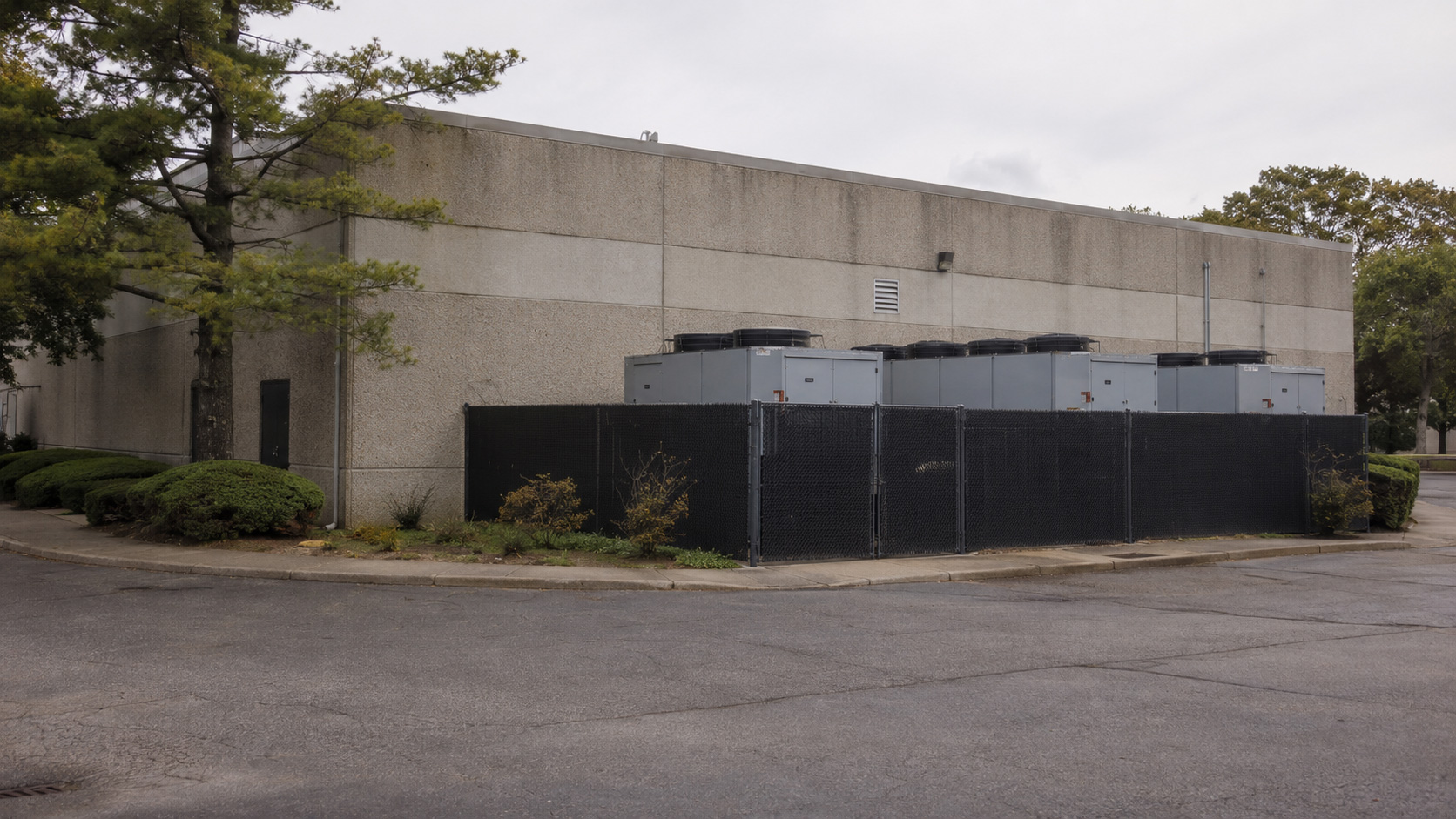
Air-cooled equipment skips the phase change. A closed loop of fluid picks up heat inside the building, carries it to equipment outside, and fans blow ambient air across coils until the heat transfers to the air. The fluid, now cooler, goes back inside and does it again. The same fluid, indefinitely.
No towers. No plume. No evaporation, because nothing is evaporating.
What we chose, and what it costs
The equipment specified for this building is air-cooled. It is in the product name — air-cooled screw chillers. There is no cooling tower to install and no plumbing between the cooling system and the municipal supply, because the design does not contemplate one.
The loop is charged once, by tanker, from a source outside the county. After that it recirculates. It is a water and glycol mix, standard for equipment that has to run through a Georgia January without freezing, and it stays inside the loop. Testing, topping up if the chemistry drifts — but never dumped and refilled.
City water use at the building is restrooms and basic building needs. That is the whole of it.
Here is the part worth stating plainly:
This is the more expensive choice.
Air-cooled equipment is less efficient than evaporative. It works harder in high ambient temperatures, which Georgia has in quantity, and it consumes more electricity to reject the same heat. That shows up as capital cost and it shows up on the power bill for the life of the building.
We are not describing a sacrifice. It was a trade, and there were reasons on both sides. But the trade is real and it goes in one direction: the option we did not take is the cheaper one to run, and it is cheaper precisely because it spends something the county does not have to spare.
Why the fear travels
There is a reason this particular concern shows up at every meeting about every facility, everywhere.
The stories are true. There are places where a large facility arrived, drew heavily on a local system, and the people living there found out afterward. Georgia has had its own version of this. When someone stands up at a Council meeting and says they have read about this, they have read about it, and they are not being unreasonable to bring it into the room.
The mistake would be to treat that as an obstacle to get past. It is a pattern-match, and it is a sound one — the person doing it has correctly identified that facilities like this can have a water problem. What they cannot know from the outside is which kind of machine is being proposed, because nobody has told them, and the phrase "data center" covers both.
So the answer is not that the concern is wrong. The answer is: that concern is about evaporative cooling, this is not evaporative cooling, and here is how to check.
How to check
Assertions from an applicant are worth what you would expect. So the mechanism matters more than the claim.
Closed-loop cooling with no municipal water used for cooling has been submitted to the City as a requested condition of approval — not as a statement of intent on a website, but as a term the City can enforce against the approval itself. If the building were later plumbed into the municipal supply for cooling, that would not be a broken promise. It would be a violated condition, with the approval itself at stake.
That is the difference between something we said and something we can be held to. It is also, frankly, the only reason to believe this page rather than simply reading it.
The honest limit
One more thing, because it will otherwise be discovered rather than disclosed.
A sealed system is not a system that cannot leak. It is a system built so that a leak is small, contained, and known about immediately. There are sensors at valve locations reporting continuously to the building management system. If one detects moisture, the system alarms; if it detects enough, it isolates that unit on its own, without anyone standing there. Containment stays on site. Anything above the regulated volume gets reported to the EPA, whether or not anyone noticed.
We would rather write that here than have someone find it in a filing later. The glycol in the loop is the same class of fluid used in car coolant and in the HVAC systems of most large buildings in this city — not exotic, not alarming, and worth naming plainly rather than leaving to be discovered.
What this is not
It is not a claim that this building has no environmental cost. It uses electricity, and electricity has to come from somewhere.
It is a narrower claim, which is that the specific fear about water — the millions of gallons, the drought, the plume — describes a machine that is not being proposed here. Not because we found a clever workaround, and not because we are better than anyone. Because we bought different equipment, and paid more for it, and the equipment does not work that way.